
Rubber Safety Surfacing
Rubber surfacing absorbs the energy of a fall and takes away the most dangerous quality of a hard floor.
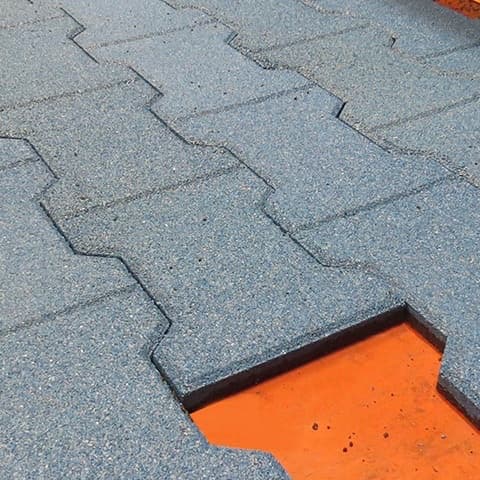
The job of a rubber surface is to spread an impact over time. The granules compress under load and spring back, so the energy of a falling child is met over a few milliseconds rather than all at once. On concrete or asphalt that cushion simply is not there.
Tile thickness is chosen for the free fall height of the equipment above it. The higher the slide platform, the thicker the surfacing has to be; an area with nothing to climb on does well with a thin tile. Choosing thickness without regard to height makes the floor either needlessly expensive or unsafe.
Ground preparation decides as much as the surfacing itself. A tile laid over a base that holds water and moves will lift at its edges. We lay it on compacted granular fill or a concrete screed, set a fall that takes surface water one way, and close the edges with a kerb so the tiles cannot creep.
Frequently asked questions
Tiles go down quickly and a damaged piece can be swapped on its own. Wet-pour gives a seamless surface and a cleaner result on curved areas. We weigh the geometry of the area against how it will be maintained.
It cannot. If the ground beneath settles, the surfacing settles with it and the joints open. Compacted granular fill or a concrete screed is prepared first, with a fall that sheds water.
Get a quote for Rubber Safety Surfacing
Tell us the length and the condition of the ground; we will send your detailed quote within 48 hours of the survey.